The Misdiagnosis That Costs You Growth
You’re growing, and everything feels harder than it should. Decisions stall. Teams build things nobody asked for. Your best people look tired. So you do what most CEOs and founders do: you reach for more structure, with new approval layers, new tools, and a thicker policy binder.
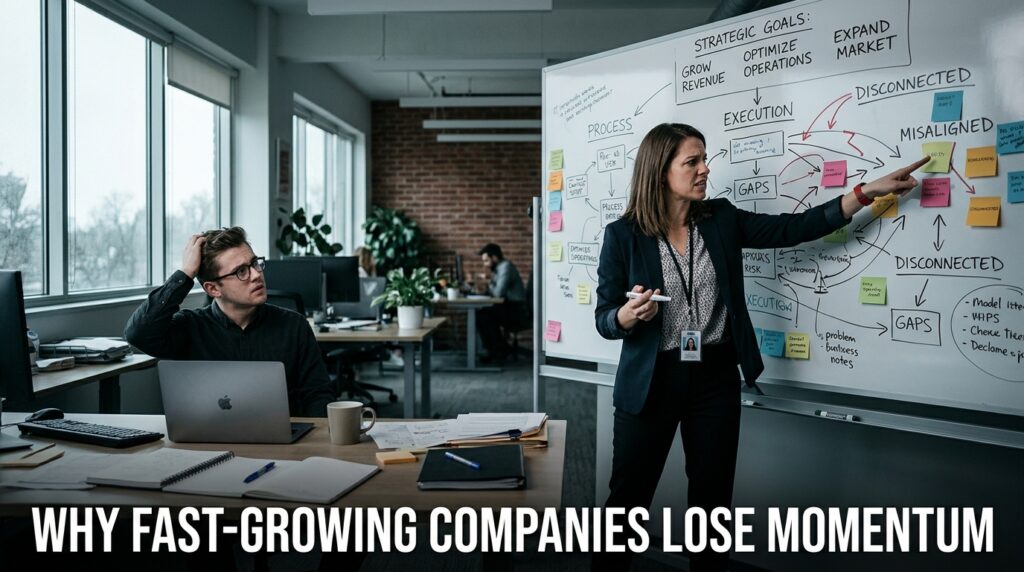
Here’s the contrarian take: more structure is often the wrong first move. The chaos you’re feeling usually isn’t a process deficit. It’s a gap between what your strategy says and what your organization actually does every day. Add rules on top of that gap and you get slower work, not better work.
Operational scaling for growth-stage startups starts with finding where strategy and execution part ways. Once you see that, the right amount of structure becomes obvious, and it’s often much less than you feared.
What the Pattern Looks Like (And Why You Might Not See It Yet)
The breakdown follows a familiar arc. Early on, a small team with a sharp product and a few committed customers can brute-force almost anything. Founders make every call, everyone knows the priorities, and speed covers a lot of gaps. Success makes the company look healthy, so nobody examines how the work actually flows.
Then growth arrives. New hires dilute context. Handoffs multiply between sales, product, and delivery. Leaders slip into survival mode, solving this week’s fire instead of next quarter’s direction. Clarity fades first, and the rest tends to follow: strong people leave, margins erode quietly, and projects that once took weeks start taking months.
The tricky part is that revenue can keep climbing while this happens. The warning signs show up in friction, not in the P&L, so they’re easy to explain away as "growing pains."
Sarah Marshall has watched this pattern repeat for more than 30 years across software, hardware, consumer electronics, biotech, and chemicals. The products differ wildly. The pattern doesn’t. A biotech scaling a lab-to-market process and a SaaS company scaling a go-to-market motion break down in strikingly similar ways: the strategy lives in a slide deck, and the work runs on habit.
The Systems-Thinking Approach: Where Strategy Meets Execution
Operations isn’t about more rules. It’s about clarity, alignment, and what Sarah calls parsimonious structure: just enough to drive performance without killing agility. Over-structure and you smother the speed that got you here. Under-structure and chaos takes over. The skill is in finding the line between them.
That’s the idea behind the Value Delivery Spine, her framework for bridging strategic vision and operational delivery. It focuses on optimizing each handoff from strategy to execution. Each handoff is a place where meaning can get lost. Her view on structure is parsimonious, just enough to drive clarity, alignment and performance. If you want a closer look at that first link in the chain, our piece on how to lead a strategic planning process covers why plans stall between the boardroom and the team.
For growing startups, the sequence matters too. Institutionalize only what’s necessary, and in order: practices first, then policy, then process, then selective automation. Skipping straight to tools is how companies end up with expensive software that automates confusion.
How a Diagnostic Assessment Reveals Your Real Problem
Before you add anything, find out what’s actually broken. At Operations Architect, we start with a Diagnostics Assessment that runs 2-4 weeks, built on our InsightOps framework. It is the first step on our engagement path, built to give you clarity before action.
It’s clarity before action, one of our core values. It’s clarity before action. You may discover that two executives define your priorities differently, that decision rights overlap in a way that slows every launch, or that a single handoff accounts for most of your delays. These are specific, fixable findings, which beats a vague sense that "operations needs work."
From there, a Strategy Roadmap takes 1-2 weeks, using our ClarityMap framework to turn findings into sequenced, executable steps your team can own. If your leaders need new skills to carry the plan, Corporate Training also runs 1-2 weeks. The point is a roadmap grounded in your reality, not a generic template. Some leaders want ongoing help carrying it out, and that’s where a fractional COO can fit.
Three Questions Every Founder Should Ask Right Now
You can start the diagnosis yourself today. Put these three questions to your leadership team, and pay attention to how long the answers take.
First, can your leaders articulate your strategy in the same words? Ask each of them separately, in writing, and compare. Differences in wording often reveal differences in direction.
Second, do your org structure and decision rights support that strategy, or do they fight it? If the people accountable for an outcome can’t make the calls that affect it, you have a design problem, not a performance problem.
Third, are you adding process because you need it, or because chaos feels scary? Be honest. Process added out of anxiety tends to stick around long after the anxiety fades.
If these questions surface more than you expected, the free self-assessments and videos on our site are a good next step.
The First Step: Stop Guessing, Start Diagnosing
Guessing is expensive in 2026, when leaders are also deciding how to adopt AI and other emerging technology on top of everything else. A clear read on where you stand makes each of those decisions easier.
The first step is a complimentary discovery consultation. It is the first step for every new client. The goal is to help you scale without burning out your people.
Before you book, run the three questions above with your leadership team this week. Write down where the answers differ, bring them to the call, and we’ll start from what’s actually going on.
Sources
- https://www.innovamarketinsights.com/webinars/global-consumer-trends-2026
- https://blog.novachem.com/nova-knows/nova-officials-weigh-in-on-sustainability-tariffs-and-more-for-2026
Frequently Asked Questions
What's the difference between adding more structure and fixing the real operational problem?
More structure is often the wrong first move. The chaos you're feeling usually isn't a process deficit but a gap between what your strategy says and what your organization actually does every day. Add rules on top of that gap and you get slower work, not better work. The real fix is finding where strategy and execution part ways, then applying just enough structure to drive performance without killing agility.
How can I tell if my company is experiencing operational breakdown?
Warning signs show up as friction, not in the P&L: decisions stall, teams build things nobody asked for, your best people look tired, and projects that once took weeks start taking months. The tricky part is that revenue can keep climbing while this happens, so the breakdown is easy to explain away as growing pains. You can start diagnosing by asking your leadership team three questions separately: can they articulate your strategy in the same words, do your org structure and decision rights support that strategy, and are you adding process out of anxiety rather than necessity.
What does a diagnostic assessment actually do?
A Diagnostics Assessment runs 2-4 weeks and is built on our InsightOps framework. This is clarity before action.
Schedule a complimentary consultation to talk through where your operations stand.